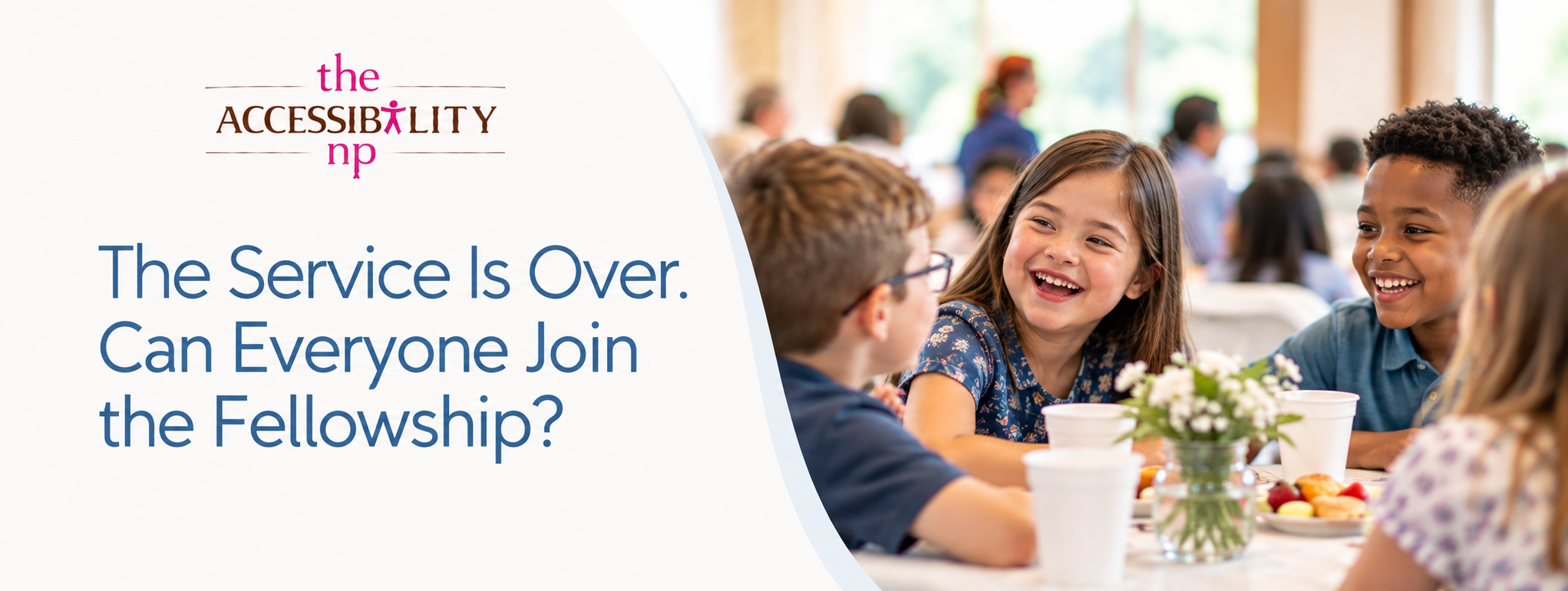
Worship has ended. The final song has been sung, the closing prayer has been offered, and people begin gathering their belongings. Some stop in the sanctuary to greet friends. Others make their way toward the fellowship hall for coffee, a meal, or conversation. Maybe it is the first Sunday of the month and everyone has been invited to stay for lunch. Perhaps there is a reception, Bible study, ministry meeting, children’s activity, or another opportunity to connect.
We often think of these moments as the informal part of church. The service is over, and now everyone can relax, eat, talk, and enjoy one another. But I think we should be careful about treating fellowship as something separate from the church experience.
These moments matter.
This is where relationships are often built. It is where the visitor who quietly attended worship has an opportunity to meet someone. It is where a family begins to feel connected. It is where people learn one another’s names, hear each other’s stories, share meals, laugh together, discover common interests, and begin forming the relationships that turn attending a church into belonging to a church community.
So when we talk about accessibility in faith communities, our evaluation cannot end when the worship service ends. We have to follow people beyond the sanctuary and into the fellowship hall.
Can everyone get there? Can everyone find a place at the table? Can everyone access the food? Can everyone communicate? Can everyone comfortably participate in the conversation? Can everyone stay and enjoy the experience?
Because there is a meaningful difference between being welcomed into worship and being included in fellowship.
Accessibility Does Not End at the Sanctuary Door
Churches may put considerable thought into making the worship space accessible. There may be designated accessible parking, a ramp, an elevator, accessible seating, large print materials, captioning, assistive listening systems, or other supports. All of those things matter.
But accessibility is an experience, not a single destination inside a building.
If someone can enter the sanctuary but cannot independently reach the fellowship hall, we still have an accessibility issue. If someone can participate in worship but cannot navigate the room where everyone gathers afterward, we still have an accessibility issue. If someone can reach the fellowship hall but there is no seating that works for them, we still have an accessibility issue. And if someone can sit at the table but cannot access the meal, communicate comfortably, or participate in the conversation, we still have an accessibility issue.
The question cannot simply be, “Can a disabled person attend our worship service?”
We have to ask a much broader question.
Can a disabled person participate in the life of our church?
Think about what happens immediately after worship. Everyone begins moving at once. People stand in the aisles talking. Children may be trying to find parents or friends. Groups form in hallways. Doors are opening and closing. Volunteers may be setting up additional tables, moving chairs, or pushing carts toward another part of the building.
A hallway that was easy to navigate before worship may look very different when a hundred people are trying to move through it at the same time.
This is why accessibility has to be evaluated when a space is actually being used. A hallway may technically be wide enough, but what happens when people stop in the middle of it to talk? An accessible route may work perfectly until folding chairs, decorations, boxes, or serving carts are placed along the wall. A fellowship hall may appear spacious when it is empty, but once additional tables and chairs are added for a church meal, the pathways may become extremely narrow.
Sometimes we evaluate accessibility by looking at the building.
We also need to evaluate what happens to the building when people fill it.
One of the simplest things a church can do is start in the sanctuary after worship and physically follow the same route people take to fellowship. Is the route clearly marked? Are there stairs? Is there an elevator, and is it easy to locate? Does the accessible route send someone in a completely different direction from everyone else? Are the doors heavy? Are there difficult thresholds? Can someone using a mobility device move through the hallway when other people are standing there talking?
Accessibility should follow the person throughout the church experience.
Is There Really a Place for Everyone at the Table?
Church fellowship often happens around tables, which means seating deserves more attention than simply making sure there are enough chairs.
Walk into many fellowship halls and you will find folding tables surrounded by chairs. It is a familiar setup and one that works well for many people. But look at that same room through an accessibility lens.
How tightly are the tables arranged? Is there enough room to move between them after people are seated? Can someone using a mobility device reach different areas of the room? Are there places at the tables where someone can comfortably position themselves without requiring several people to move?
More importantly, does that person have choices?
Choice is something we do not discuss enough when we talk about accessibility. Sometimes we technically provide access while significantly limiting someone’s options.
A person may be able to sit at the end of one particular table, for example, but nowhere else. We may see that as successful accessibility because we found a place for them. But what if their friends are sitting at another table? What if their family is sitting across the room? What if the only available space places them beside a busy doorway, the serving line, a speaker, or another high traffic area?
We should be careful about defining accessibility as simply finding somewhere a disabled person can fit.
That is not the same thing as inclusion.
If everyone else walks into the fellowship hall and chooses where they want to sit based on who they want to talk to, disabled people should have as much opportunity as possible to make those same social choices.
Sometimes that means leaving open spaces at different tables instead of creating one designated place. Sometimes it means arranging tables farther apart. Sometimes it simply means thinking about mobility and seating before the room fills rather than trying to rearrange everything after someone arrives.
The goal should be to create an environment where people have meaningful choices about where they sit, who they sit with, and how they participate.
What Happens When Fellowship Includes Food?
Food is such a familiar part of church fellowship that we may not stop to think about how someone actually accesses it.
Buffet style meals are common in churches. They are practical, familiar, and allow people to choose what they would like to eat. But a buffet can also introduce accessibility barriers that may not be obvious until we intentionally look for them.
How high are the serving tables? Can everyone see and reach the food? Are serving dishes pushed toward the back of the table? Are labels available and readable? Are utensils easy to use? Does someone need to hold a plate while serving themselves? Is there enough room to navigate the line with a mobility device? What happens when the serving area becomes crowded?
Now consider someone who needs assistance carrying a plate or drink. What about someone who cannot independently use the serving utensils? What about a person who needs information about ingredients? What about someone who communicates differently and may need additional time to indicate what they would like?
The answer is not that churches should stop having buffet meals.
The answer is that we should think more intentionally about how people access them.
Perhaps volunteers can be available to assist when requested. Maybe someone can carry a plate to the table. Food can be positioned within easy reach. Labels can be clear and readable. Serving areas can have enough space for people to move comfortably. Someone who cannot navigate the line may be able to have a meal brought to the table.
Accessibility does not always require an entirely different way of doing something.
Sometimes it simply requires options.
Food itself can also affect whether someone feels comfortable participating. Some people have allergies or dietary restrictions. Others may have texture needs, swallowing needs, adaptive utensils, feeding equipment, or specialized diets. Someone may need assistance eating. Another person may need to bring food from home.
A church cannot anticipate every person’s dietary needs, nor should that be the expectation. But a church can create an environment where people feel comfortable asking questions and bringing what they need without being made to feel as though they are disrupting the gathering.
Food can be labeled when possible. Ingredient information can be made available. People can be allowed to bring their own food when necessary. And someone’s food needs do not need to become the subject of conversation at the table.
Hospitality is not simply providing food.
Hospitality is creating an environment where people can eat, participate, and connect with dignity.
When the Fellowship Hall Becomes Too Loud
Think about what a fellowship hall sounds like when it is full.
Dozens of conversations may be happening at once. Chairs scrape across the floor. Children are playing. Dishes are clattering. Coffee is being poured. Someone is laughing across the room. Volunteers are cleaning tables. Music may be playing in the background while someone else is trying to make an announcement.
For some people, this is the wonderful sound of community.
For others, it can make participation incredibly difficult.
Someone who is hard of hearing may struggle to follow a conversation when several voices are competing with background noise. A person using a communication device may have difficulty being heard. Someone with sensory sensitivities may find the environment overwhelming. Another person may be able to participate comfortably for a while but eventually need a quieter place before joining the group again.
Noise is an accessibility consideration.
That does not mean fellowship halls have to become silent. It means we should think about the options available within the environment.
Could some tables be positioned farther away from the busiest areas? Does background music really need to be playing while dozens of people are already talking? Is there a quieter space nearby where people can still connect? Can someone step away and return when they are ready? Do church leaders understand that someone leaving a noisy room for a while is not necessarily being antisocial or uninterested in fellowship?
Sometimes accessibility is not about changing the entire environment for everyone.
It is about providing another way for someone to participate comfortably.
Being in the Room Is Not the Same as Being in the Conversation
This is where I think we have to go deeper.
A disabled person can be physically present in the fellowship hall and still be socially excluded.
Communication after worship is very different from communication during worship. During the service, communication is usually structured. One person speaks while others listen. Words may be projected. There may be printed materials, captions, an interpreter, or assistive listening technology.
Fellowship is different.
Conversations move quickly. People interrupt one another. Topics change. Groups form and separate. Someone joins a conversation halfway through. Another person speaks from across the table. Three people begin talking at the same time. Someone makes a joke, everyone laughs, and the conversation has moved on before another person has had time to respond.
This can create barriers for people who are Deaf, hard of hearing, have communication disabilities, use augmentative and alternative communication, process language differently, or need additional time to respond.
Inclusive fellowship requires us to reconsider what we think conversation is supposed to look like.
Not everyone communicates at the same speed. Not everyone communicates using speech. Not everyone can follow a conversation when several people are talking at once. And not everyone can easily enter a conversation that is already moving quickly.
Sometimes accessibility means slowing down.
It may mean facing someone when speaking. It may mean giving someone enough time to respond. It may mean speaking directly to the disabled person rather than automatically directing conversation toward the family member or support person sitting beside them. It may mean allowing someone using a communication device time to compose a message without becoming uncomfortable with the silence and answering for them.
Communication access is not simply about exchanging information.
It is about making room for someone’s voice.
We also have to pay attention to who is actually being invited into the conversation. A disabled person may be sitting at the table but rarely included. People may speak primarily to the person accompanying them. Someone may assume they cannot participate. Others may feel uncertain about how to communicate, so they avoid trying altogether.
This is where accessibility and belonging intersect.
We cannot measure inclusion only by who is in the room.
We also have to notice who is being engaged.
Who is being asked questions? Who is being introduced? Who is being invited into conversations? Who is being listened to? Who is being given enough time to communicate? Who is being treated as someone worth getting to know?
Fellowship is relational.
If disabled people are consistently present but remain on the edges of the church’s social life, physical accessibility alone has not created inclusion.
What About Disabled Children and Teens?
We need to think about what fellowship looks like for disabled children and teenagers too.
When worship ends, children may head toward the fellowship hall, playground, youth room, or activity area. Teenagers may gather together while their parents are talking. Friends find one another. Games begin. Plans are made. Someone invites someone else to sit with them.
Can disabled children and teenagers participate in those informal parts of church life with their peers?
Accessibility should not end with making sure a disabled child can attend Sunday school or sit through worship.
Are activities after worship designed in ways that allow different types of participation? Can everyone access the playground or youth room? Are there options when a particular activity does not work? Do peers understand that someone may communicate or participate differently? Are youth leaders prepared to adapt an activity rather than automatically separating a disabled child from the group?
And perhaps one of the most important questions is whether the unspoken expectation is that a disabled child will remain beside a parent or support person while everyone else interacts more independently.
Support may absolutely be necessary. But support should help facilitate participation rather than automatically becoming a substitute for peer relationships.
The friendships children and teenagers develop in faith communities can be incredibly meaningful. We should consider whether disabled children have access not only to the church program but also to the friendships, conversations, celebrations, games, meals, youth activities, and ordinary moments surrounding that program.
Those moments are part of belonging too.
The Small Details Can Determine Whether Someone Stays
Sometimes the things that determine whether someone can remain for fellowship seem relatively small until they become a barrier.
Restroom access is one example.
Where is the accessible restroom? Is it near the fellowship space? Is the route clear? Is it clearly marked? Does the door function properly? Is the space actually usable?
And has it become a storage area?
It is surprisingly easy for an accessible restroom, hallway, or other space to slowly accumulate extra chairs, boxes, cleaning supplies, seasonal decorations, or other items. The accessibility feature still exists on paper, but it may no longer work in practice.
The same thing can happen with seating areas, hallways, ramps, and accessible entrances.
Accessibility features have to remain accessible.
Other details can affect how long someone stays too. Is there seating available for someone who cannot comfortably stand during extended conversations? Is there somewhere quieter to take a break? Can someone leave the fellowship hall and return without feeling as though they are disrupting the gathering? Is the room becoming increasingly crowded? Is there enough space to move around once everyone arrives?
The people serving in these environments also matter.
Ushers, hospitality teams, food service volunteers, ministry leaders, greeters, and other volunteers have enormous influence over whether fellowship feels accessible and welcoming.
They do not need to become disability experts.
But they should understand some basic principles of accessible hospitality.
Ask before helping. Speak directly to disabled people. Do not move someone’s mobility or communication equipment without permission. Do not assume someone needs assistance simply because they are disabled. At the same time, make assistance easy to request. Avoid turning someone’s needs into a public announcement. And when someone identifies a barrier, respond with curiosity rather than defensiveness.
Sometimes one of the most helpful questions we can ask is simply, “What would make this work better for you?”
The person experiencing the barrier may already know exactly what would help.
Fellowship Is Part of Church Life
Sometimes we unconsciously treat everything after worship as optional.
The service was the important part. Fellowship is just coffee. Lunch is just lunch. Standing around talking afterward is just socializing.
But think about how church communities actually function.
Someone finds a small group because of a conversation over coffee. A new family meets another family during a church dinner. An older member finds companionship at a ministry luncheon. A teenager begins forming friendships during youth activities. Someone learns about an opportunity to serve because they stayed after church and talked with a ministry leader.
A visitor becomes a familiar face.
A familiar face becomes a friend.
A friend begins to feel like part of the community.
Much of the relational life of a church happens outside the formal worship service.
That means accessibility cannot stop with worship.
If disabled people can attend the service but repeatedly encounter barriers to the places where relationships are built, they may technically have access to church while still being excluded from an important part of church life.
And this is why I believe fellowship deserves to be part of our accessibility conversations.
Coffee after worship is not always just coffee.
The church dinner is not always just lunch.
The conversation in the hallway is not always just small talk.
These ordinary interactions are often where relationships begin.
If those relationships are part of what makes someone feel connected to a faith community, then access to those spaces and experiences matters.
Follow the Experience Beyond the Sanctuary
One of the most valuable things a faith community can do is walk through the entire fellowship experience from beginning to end.
And I do mean walk through it when the church is full, not only when the building is empty.
Start when worship ends.
Follow the crowd.
Notice the pathways. Go into the fellowship hall. Look at the room after all the tables and chairs are in place. Stand in the serving line. Sit at different tables. Listen to the noise level. Locate the accessible restroom. Look at where disabled children and teenagers are participating. Pay attention to how people move through the space and where congestion happens.
Then pay attention to the social experience.
Who can easily join a table?
Who is being included in conversations?
Who is communicating?
Who is being spoken to directly?
Who seems to be on the edge of the gathering?
Who has choices?
Who can stay?
Then talk with disabled members, visitors, and families.
Ask about their experiences.
There may be barriers they identify that would never appear on a standard accessibility checklist. The building may technically be accessible while the experience tells a very different story.
We need both perspectives. We need to understand accessibility standards, good design, communication access, sensory considerations, assistive technology, and other accessibility practices. But we also need to listen to the people actually navigating our spaces.
A church may sincerely believe that everyone is welcome. I believe most faith communities genuinely want people to feel that way.
But that welcome should follow people beyond the sanctuary.
It should be reflected in the pathway to the fellowship hall. It should be reflected in how the tables are arranged. It should be reflected in how food is served. It should be reflected in how people communicate. It should be reflected in whether someone has access to a quieter space when they need one. It should be reflected in how disabled children and teenagers are included with their peers. It should be reflected in the attitudes of volunteers. And it should be reflected in whether disabled people are not only present but genuinely part of the relationships being built.
Accessibility in faith communities is not about creating a separate experience for disabled people.
It is about making sure the shared experience has room for them.
The service may be over, but the ministry of hospitality is not.
The conversations after worship matter. The shared meals matter. The laughter around the table matters. The friendships formed in the fellowship hall matter. The children’s activities matter. The cup of coffee with someone who remembered your name matters. The invitation to sit at a table matters. The ordinary moments of connection matter.
If those moments are part of how a church becomes a community, then disabled people should have meaningful access to them too.
So the next time the final prayer is offered and everyone begins making their way toward coffee, lunch, conversation, or the next church activity, do not stop evaluating accessibility at the sanctuary door.
Follow the experience beyond it.
Look at who can get there. Notice who can move through the space comfortably. Consider who has choices about where they sit. Pay attention to who can access the meal. Listen to the environment. Notice who is part of the conversation and who may be sitting quietly on the edge of it. Think about who can stay and who may have to leave because the environment no longer works for them.
Because the goal should never be simply to make sure everyone can attend church.
We should be working toward faith communities where disabled people can worship, participate, serve, build relationships, share meals, join conversations, develop friendships, and experience the ordinary moments of community that make a church feel like home.
The service may be over.
But belonging should not end with the benediction.
Until next time… keep making space for everyone.